Showing posts with label overcurrent. Show all posts

Sunday, June 14, 2015

Circuit Breakers

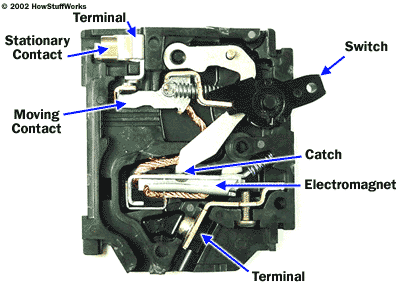
Another device used for overcurrent protection is a circuit breaker.circuit breaker is a device designed to open and close a circuit by nonautomatic means, and to open the circuit automatically on a predetermined overcurrent without damage to itself when properly applied within its rating.

Circuit breakers provide a manual means of energizing and de-energizing a circuit. In addition, circuit breakers provide automatic overcurrent protection of a circuit. A circuit breaker allows a circuit to be reactivated quickly after a short circuit or overload is cleared. Unlike fuses which must be replaced when they open, a simple flip of the breaker’s handle restores the circuit.

Like fuses, every circuit breaker has a specific ampere, voltage, and fault current interruption rating. The ampere rating is the maximum continuous current a circuit breaker can carry without exceeding its rating. As a general rule, the circuit breaker ampere rating should match the conductor ampere rating.

Generally the ampere rating of a circuit breaker is selected at 125% of the continuous load current. This usually corresponds to the conductor ampacity which is also selected at 125% of continuous load current. For example, a 125 ampere circuit breaker would be selected for a load of 100 amperes.

The voltage rating of the circuit breaker must be at least equal to the circuit voltage. The voltage rating of a circuit breaker can be higher than the circuit voltage, but never lower.

Circuit breakers are also rated according to the level of fault current they can interrupt. When applying a circuit breaker, one must be selected which can sustain the largest potential short circuit current which can occur in the selected application.
Saturday, June 13, 2015

Electrical Power Circuit Protection


Circuit protection must be taken into consideration with any electrical circuit, including busway. Current flow in a conductor always generates a watts loss in the form of heat. As current flow increases, the conductor must be sized appropriately in order to compensate for higher watt losses. Excess heat is damaging to electrical components. For that reason, conductors have a rated continuous current carrying capacity or ampacity.Overcurrent protection devices are used to protect conductors from excessive current flow. Two devices used to protect circuits from overcurrent are fuses and circuit breakers. These protective devices are designed to limit the flow of current in a circuit to a safe level, preventing the circuit conductors from overheating.

overcurrent is any current in excess of the rated current of equipment or the ampacity of a conductor. It may result from overload, short circuit, or ground fault.

Circuit protection would be unnecessary if overloads and short circuits could be eliminated. Unfortunately, overloads and short circuits do occur. To protect a circuit against these currents, a protective device must determine when a fault condition develops and automatically disconnect the electrical equipment from the voltage source.

An overcurrent protection device must be able to recognize the difference between overcurrents and short circuits and respond in the proper way. Protection devices use an inverse time-current characteristic. Slight overcurrents can be allowed to continue for some period of time, but as the current magnitude increases, the protection device must open faster. Short circuits must be interrupted instantly.

A fuse is the simplest device for interrupting a circuit experiencing an overload or a short circuit. A typical fuse, like the one shown below, consists of an element electrically connected to end blades or ferrules. The element provides a current path through the fuse. The element is enclosed in a tube and surrounded by a filler material.

Current flowing through the element generates heat, which is absorbed by the filler material. When an overcurrent occurs temperature in the element rises. In the event of a harmless transient overload condition the excess heat is absorbed by the filler material. If a sustained overload occurs the heat will eventually melt open an element segment forming a gap; thus stopping the flow of current.

Short-circuit current can be several thousand amperes and generates extreme heat. When a short circuit occurs several element segments can melt simultaneously, which helps remove the load from the source voltage quickly. Short-circuit current is typically cut off in less than half a cycle, before it can reach its full value.

Nontime-delay fuses provide excellent short circuit protection. Short-term overloads, such as motor starting current, may cause nuisance openings of nontime-delay fuses. They are best used in circuits not subject to large transient surge currents. Nontime-delay fuses usually hold 500% of their rating for approximately one-fourth second, after which the current carrying element melts. This means that these fuses should not be used in motor circuits which often have inrush (starting) currents greater than 500%.

Time-delay fuses provide overload and short circuit protection. Time-delay fuses usually allow five times the rated current for up to ten seconds. This is normally sufficient time to allow a motor to start without nuisance opening of the fuse unless an overload persists.

Fuses have a specific ampere rating, which is the continuous current carrying capability of a fuse. The ampere rating of a fuse, in general, should not exceed the current carrying capacity of the circuit. For example, if a conductor is rated for 10 amperes, the largest fuse that would be selected is 10 amperes.

There are some specific circumstances when the ampere rating is permitted to be greater than the current carrying capacity of the circuit. For example, motor and welder circuits can exceed conductor ampacity to allow for inrush currents and duty cycles.

The voltage rating of a fuse must be at least equal to the circuit voltage. The voltage rating of a fuse can be higher than the circuit voltage, but never lower. A 600 volt fuse, for example, can be used in a 480 volt circuit. A 250 volt fuse could not be used in a 480 volt circuit.

Fuses are also rated according to the level of fault current they can interrupt. This is referred to as ampere interrupting capacity (AIC). When applying a fuse, one must be selected which can sustain the largest potential short circuit current which can occur in the selected application. The fuse could rupture, causing extensive damage, if the fault current exceeds the fuse interrupting rating.


Friday, June 12, 2015

Fuses


Circuit protection would be unnecessary if overloads and short circuits could be eliminated. Unfortunately, they do occur. To protect a circuit against these destructive currents, a protective device must determine when a fault condition develops and automatically disconnect the electrical equipment from the power source. A fuse is the simplest device for interrupting a circuit experiencing an overload or a short circuit.

A typical fuse consists of an element electrically connected to ferrules. These ferrules may also have attached end blades.The element provides a current path through the fuse. It is enclosed in a tube, and surrounded
by a filler material.

Current flowing through the fuse element generates heat, which is absorbed and dissipated by the filler material. When an overcurrent occurs, temperature in the element rises. In the event of a transient overload condition the excess heat is absorbed by the filler material. However, if a sustained overload occurs, the heat will eventually melt open an element segment. This will stop the flow of current.

Fuses have an inverse time-current characteristic. The greater the overcurrent, the less time it takes for the fuse to open. This is referred to as the clearing time of the fuse.

Short-circuit current can be several thousand amperes, and generates extreme heat. When a short circuit occurs several element segments can melt simultaneously, which helps remove the load from the power source quickly. Short-circuit current is typically cut off in less than half a cycle, before it can reach its full value.

Non time-delay fuses provide excellent short circuit protection. However, short-term overloads, such as motor starting current, may cause nuisance openings of nontime-delay fuses. For this reason, they are best used in circuits not subject to large transient surge currents. Nontime-delay fuses usually hold 500% of their rating for approximately one-fourth of a second, after which the current-carrying element melts. This means that these fuses should not be used in motor circuits, which often have starting currents greater than 500%.

Time-delay fuses provide both overload and short-circuit protection. Time-delay fuses usually allow five times the rated current for up to ten seconds. This is normally sufficient time to allow a motor to start without nuisance opening of the fuse. However, if an overload condition occurs and persists, the fuse
will open.